Installing ArtiSynth from GitHub into Eclipse (Windows)
Last updated: October, 2026
1 Overview
This document describes how to install ArtiSynth directly from GitHub and import it into the Eclipse IDE (Integrated Development Environment), within a Windows environment. While for demonstration purposes it is faster to install ArtiSynth using a precompiled release, installing from GitHub provides access to the most recent updates, and the Eclipse IDE is a convenient platform for developing and modifying the Java code used to create ArtiSynth models.
There are two parts to the installation process:
-
1.
Installing Eclipse
-
2.
Installing ArtiSynth from GitHub
Eclipse comes with its own version of Java, which is sufficient for compiling and running ArtiSynth within Eclipse, so you do not need to install Java separately. A separate Java development kit (JDK) is needed only in special cases, as described in Section 2.1.
This document is intentionally brief and describes only installation from Git into an Eclipse IDE. More complete instructions, including how to create and add models, integrate external models, and update ArtiSynth, are given in the general Installation Guide. Instructions for visualizing, navigating, editing and simulating models are given in the ArtiSynth User Interface Guide. Instructions on how to build a model using Java are given in the ArtiSynth Modeling Guide.
2 System Requirements
Your host machine should be a 64-bit system based on an Intel or AMD processor (often referred to as x86_64, x64 or amd64). We recommend a minimum of 16 Gbytes of memory, and more is better if you are doing finite element work with larger numbers of elements.
2.1 Java requirements
You should use Java 21 or later. While ArtiSynth is currently compiled to be compatible with Java 8, this will be raised to Java 21 in the near future. The version of Java that comes with Eclipse (Java 21 or later for Eclipse 2024-09 and newer) meets this recommendation and is used by default to compile and run ArtiSynth.
You will need to install a separate Java development kit (JDK) only if
-
•
you want to compile or run ArtiSynth from a terminal window, outside of Eclipse; or
-
•
you need a specific version of Java. In particular, if you plan to use ArtiSynth with MATLAB, ArtiSynth should be run with Java 21, which is compatible with recent versions of MATLAB (see Interfacing ArtiSynth to MATLAB), whereas newer versions of Eclipse come with later versions of Java.
If either of these apply, see Section 7.
3 Installing Eclipse
Eclipse is an integrated development environment (IDE) that is commonly used for writing and maintaining Java programs. While other IDEs exist for Java, such as IntelliJ and VS Code, Eclipse is currently the most commonly used amongst ArtiSynth users. It should be noted, however, that an IDE is not required for Java programming; simpler programs, in particular, can often be created by editing the .java source files using a text editor and then compiling them with command line tools, including GNU make, if that is available, or the compile utility supplied by ArtiSynth.
Eclipse is released quarterly, with versions named by year and month (e.g., 2026-09). Any recent version should work; the instructions below use 2026-09 as an example.
Eclipse can be downloaded from www.eclipse.org/downloads/packages. From this page, choose “Eclipse IDE for Java Developers”, Windows x86_64, which will download a file named
eclipse-java-2026-09-R-win32-x86_64.zip
Unzip this into a convenient folder, such as for example:
C:\eclipse\eclipse-2026-09
Open this folder with a file explorer, and you will see the eclipse application:

Click on this to open it. The following dialog will appear, asking you to select a workspace folder:

This is where Eclipse settings and project information will be stored. Unless you have another Eclipse already installed, the default location should be fine. (Remember also to check the “Use this as the default ...” box so that this query won’t appear every time you open Eclipse.) Next, click Launch. A welcome page will appear; close this. A “donate” panel may also appear; close this too. You should then see an empty Eclipse display, similar to this:

4 Installing ArtiSynth
You can now install ArtiSynth from GitHub.
-
1.
From the panel at the left of the main Eclipse frame, choose “Import projects...”. This will cause an Import dialog to appear, as shown below. Open “Git > Projects from Git”, and then click Next.

-
2.
In the next dialog, choose Clone URI, and click Next.
-
3.
A Source Git Repository dialog will appear, as shown below. In the URI field at the top, enter
https://github.com/artisynth/artisynth_core.git
This will automatically fill the Host and Repository path fields. Click Next.
-
4.
A Branch Selection dialog will appear. If multiple branches are available, make sure that only master is selected. Click Next.
-
5.
A Local Destination dialog will appear, as shown below, indicating the folder into which ArtiSynth will be placed locally. Use the default location, or edit it to some other desired location. This will be your ArtiSynth installation folder. Click Next.

-
6.
ArtiSynth will now be downloaded; this may take a few minutes, depending on your network connection speed. Another dialog will appear, asking you to select a project import wizard. Leave the default (“Import existing Eclipse projects”) selected, and click Next.
-
7.
An Import Projects dialog will appear, confirming that you want to import artisynth_core. Leave everything as is, and click Finish.
artisynth_core has now been imported into Eclipse as a project, and Eclipse will begin to build it, first by automatically downloading the Java and native libraries that ArtiSynth needs. (These are not included in the GitHub repository because they are quite large.) The download can be on the order of 200 Mbytes, and so may take up to several minutes, depending on network speed. Its progress is shown in Eclipse’s Console view, at the bottom of the Eclipse window:
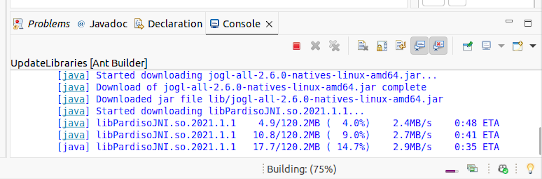
On some versions of Eclipse, the console view may need to be opened explicitly, by selecting Window > Show View > Console from the main menu.
When the download is complete, the console will display the message LIBRARIES UPDATED SUCCESSFULLY:
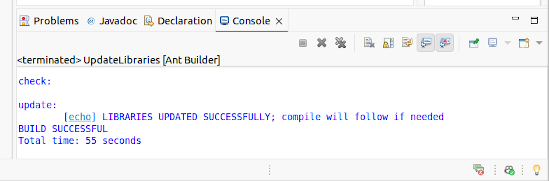
Eclipse will then compile ArtiSynth, with the progress bar at the lower right showing compilation progress.
If some libraries could not be downloaded (e.g., because of a network problem), the console will say so, and the artisynth_core project will be marked with errors. After checking your network connection, you can retry the download by selecting Run > External Tools > UpdateArtisynthLibs from the main menu, or Project > Clean....
5 Running ArtiSynth
You should now be able to run ArtiSynth. Select the imported artisynth_core project in the Package Explorer panel on the left of the Eclipse window, and choose Run > Run from the main menu:
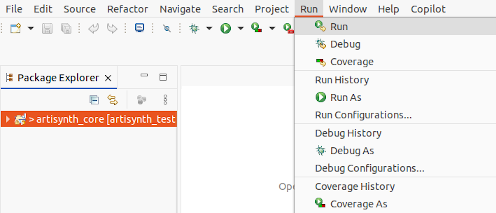
ArtiSynth will then start up (perhaps slowly the first time). Alternatively, you can click the small arrow beside the green Run button in the Eclipse toolbar, and choose ArtiSynth from the menu that appears.
Within ArtiSynth, you can then load a demonstration model by selecting Models > Demos from the main menu and choosing a demo model:

Once a model is loaded, it will appear in the viewer, and simulation can be controlled using the “play” controls located at the upper right of the application window:

From left to right, these are: step size control, which controls the simulation step size (in seconds); current simulation time (in seconds); and the reset, skip-back, play/pause, single-step and skip-forward buttons. Starting and stopping a simulation is done by clicking play/pause, and resetting it to time 0 is done by clicking reset. The single-step button advances the simulation by one time step.
A model can also be loaded by specifying either its defining class or a .art file containing its textual representation. For details, see the section “Loading, Simulating and Saving Models” in the ArtiSynth User Interface Guide. The model menu can also be customized, as described in “Customizing the Model Menu”. The interface guide also contains information on using the ArtiSynth GUI for model visualization, navigation, editing, and simulation control. Instructions on how to build a model using Java are given in the ArtiSynth Modeling Guide.
The image below shows ArtiSynth with the Spring Net demo loaded:

6 Updating ArtiSynth
To update ArtiSynth to the latest version on GitHub, right-click on artisynth_core in the Package Explorer and choose Team > Pull. If the update requires new or different libraries, they are downloaded automatically the next time Eclipse builds the project, as during installation, and libraries that are no longer needed are removed.
The pull may be refused if it would overwrite files that you have modified locally, such as ArtiSynth.launch or .classpath. Eclipse will then report an error, and clicking Details in the error dialog lists the files concerned. Information on resolving this is given in the Section “Refused pulls” in the general Installation Guide.
7 Installing a Separate JDK (Optional)
As described in Section 2.1, you need a separate JDK only to compile or run ArtiSynth from a terminal window, or to use a specific version of Java (such as Java 21 for use with MATLAB). Any JDK of version 21 or later will work. Free builds of the JDK are available from several sources; we suggest Eclipse Temurin, available from
JDKs are also available from Oracle at www.oracle.com/java/technologies/downloads but may be subject to certain licensing restrictions.
Select your operating system and architecture, the package type JDK, and the desired version (21, or later). For Windows, choose the architecture x64; the easiest option is then the .msi installer.
The home folder for a JDK install is usually something like
C:\Program Files\Eclipse Adoptium\jdk-21.0.8.9-hotspot
for Temurin and
C:\Program Files\Java\jdk-21
for Oracle.
7.1 Configuring Eclipse with the JDK
To make Eclipse use your JDK instead of its own version of Java, do the following:
-
1.
From the main menu, select “Window > Preferences”.
-
2.
A Preferences dialog will open. In the left panel, select “Java > Installed JREs”, which will open an Installed JREs panel. This will list Eclipse’s own version of Java (named jre), and possibly other JDKs that Eclipse has found on your system. If your JDK is listed, click on the box to the left of its entry to select it, and skip to the last step. Otherwise, click the Add... button at the right.
-
3.
A JRE Type dialog will appear. Leave “Standard VM” selected in the dialog and click Next.
-
4.
A JRE Definition dialog will appear. In the “JRE home” field at the top, enter the Java home folder for your JDK, as described in Section 7. This will cause some other fields to fill in automatically, as seen here:

-
5.
Click Finish. The desired JDK will now show up in the list of installed JREs. Click on the left box to select it, as shown below.

-
6.
Finish by clicking the “Apply and Close” button at the bottom of the Preferences dialog.
7.2 Making the JDK visible from a terminal window
To compile or run ArtiSynth from a terminal window, the java and javac commands of your JDK must be visible there. To check this, open a terminal window, run the command javac -version, and check that the command is found and that the version matches your JDK. The JDK installer usually takes care of this. If it has not, you can fix this by adding <JDK_HOME>\bin to your Path, where <JDK_HOME> is the home folder for your JDK as described in Section 7, making sure it is ahead of any other Java installations that might be specified on the Path.
The Path is a list of directories which the system searches in order to find executables. You can add <JDK_HOME>\bin to it as follows:
-
1.
Open the Start search, enter “env”, and choose “Edit the system environment variables”.
-
2.
Click on Environment Variables.
-
3.
Under User variables (the top window), click on Path and click Edit. If Path does not exist, click New.
-
4.
In the Edit environment variable dialog, click New and enter <JDK_HOME>\bin. Use Move Up to place it ahead of any other Java entries.
-
5.
Close all dialogs by clicking OK and restart any terminal windows.
